Building a Customer 360 View: Why It Matters for Community Institutions
In today’s digital-first world, customers expect their local financial institution to know them as well as their favorite online retailer. Meeting this expectation requires more than great service—it demands a Customer 360 view.
Key Takeaway: A Customer 360 view isn’t just a tech upgrade—it’s a strategic imperative to move from reactive service to proactive, AI-driven partnership.
What Is a Customer 360?
It is a unified, multidimensional profile that consolidates data across every touchpoint—branch visits, mobile apps, call centers, and commercial treasury portals. Instead of fragmented systems, staff gain a single source of truth about every relationship, from the college student with a first savings account to the manufacturing firm with a complex credit facility.
The Engine: How AI & Machine Learning Enhance the View
A 360 view without AI is just a digital filing cabinet. By integrating Machine Learning (ML) and Artificial Intelligence, community institutions move from viewing history to predicting the future:
- Behavioral Pattern Recognition: ML algorithms scan billions of transactions to identify “signature behaviors”—such as a consumer preparing for a move or a business entering a seasonal cash-flow crunch—long before they tell their banker.
- Entity Resolution: AI automatically cleans and links data. It recognizes that “John’s Pizza LLC” and “John Doe” (the retail customer) are the same relationship, ensuring a unified risk and opportunity profile.
- Sentiment Analysis: Natural Language Processing (NLP) analyzes call center notes and emails to gauge a customer’s frustration or satisfaction, allowing the institution to intervene before a relationship sours.
Consumer Use Cases: Personalization at Scale
- At-Risk Retention (The “Silent Churn” Signal): By monitoring cross-channel activity, AI flags when a long-time depositor lowers their average balance. This allows for proactive outreach before they move their primary relationship elsewhere.
- Frictionless Lending: Imagine a customer applying for a mortgage and finding the application already 75% pre-filled. This “pre-qualified” advantage—powered by integrated data—reduces abandonment and speeds up funding.
- Life-Stage Mapping: AI ensures marketing pivots automatically from “Student Loans” to “Wealth Management” based on real-time life events, not outdated demographics.
Commercial Use Cases: From Vendor to Strategic Advisor
- Treasury Management “Wallet Share”: ML identifies when a corporate client transfers funds to an outside payroll provider. This triggers a “Next Best Action” for an RM to pitch internal treasury services.
- Early Warning Systems (EWS): Instead of waiting for quarterly statements, AI monitors real-time liquidity. This allows risk officers to step in with restructuring options weeks before a covenant breach occurs.
- Managing Complex Hierarchies: AI maps entire corporate “family trees.” RMs can see the total aggregate exposure of a parent company and all subsidiaries, ensuring they never negotiate blind.
Why It Matters for Community Institutions
- Predictive Personalization: Use AI to deliver recommendations that prove you actually know your community.
- Operational Efficiency: Reduce internal “data hunting” and empower staff with instant, AI-generated insights.
- Smarter Risk Management: Move from backward-looking reports to real-time, ML-driven risk assessment.
Overcoming the Challenges
The path to a 360 view doesn’t require “ripping and replacing” your Core system. Success lies in an integration layer—using AI and analytics to “wrap” legacy systems and bridge the gap between departmental silos.
Implementation: The Road Ahead
Community institutions are uniquely positioned to win. Their community-first ethos aligns perfectly with the goal of delivering personalized, holistic financial experiences. By bridging tradition with innovation, they can remain the most trusted partners in their customers’ financial lives.
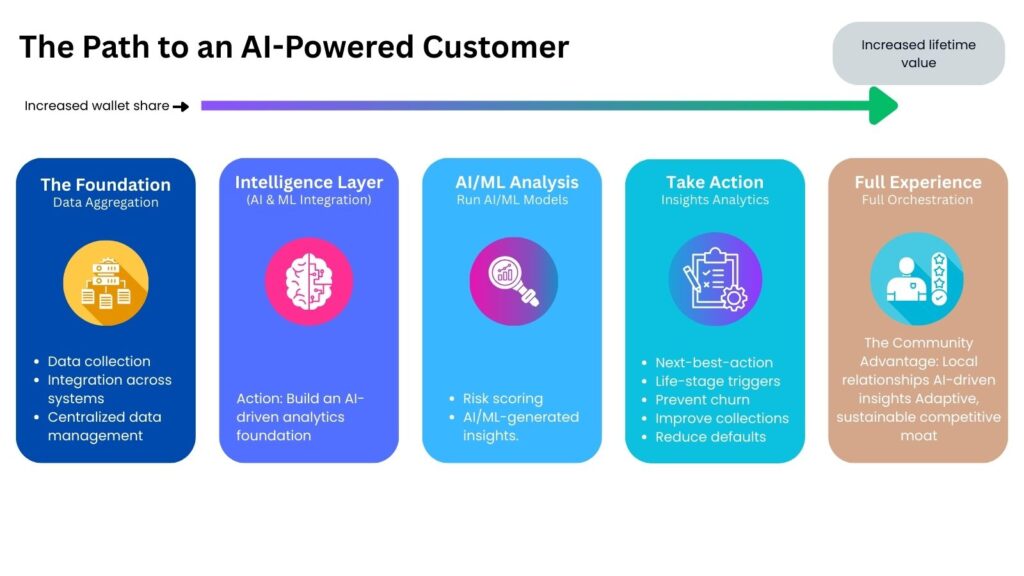
The Community Advantage
Unlike “Megabanks,” community institutions have the local context. When you combine local relationships with AI-driven insights, you create a competitive “moat” that fintechs cannot replicate.